Insights
Clear thinking for Indian and global investors.
Plain-English articles by CA. Abhishek Mandhania. Choose what you are looking for to see the articles written for you.
For NRIs & Foreign Investors
Investing in India from abroad


GIFT City Funds vs NRE/NRO Investing: Which Is Better for NRIs?
Compare investing in India through GIFT City funds with the traditional NRE/NRO route: currency, bank accounts, PAN, tax deducted at source and repatriation.
Read article →
Retail vs Non-Retail GIFT City Funds: What's the Difference?
GIFT City inbound funds come as Retail and Non-Retail schemes. Learn how they differ in entry amount, structure, dealing frequency and who they suit.
Read article →
How NRIs and Foreign Investors Can Invest in India Through GIFT City: A Step-by-Step Guide
A practical, step-by-step guide for NRIs, OCI cardholders and foreign nationals on investing in India through GIFT City funds: eligibility, documents and process.
Read article →
Tax on GIFT City Funds for NRIs: The India Side and What to Ask at Home
How GIFT City inbound funds are generally taxed in India for non-residents, and the home-country questions NRIs in the UAE, USA, UK, Singapore and elsewhere should ask.
Read article →
How NRIs Repatriate Money from India: NRE, NRO and the US$ 1 Million Limit
How NRIs move money out of India: what is freely repatriable from NRE accounts, the US$ 1 million limit on NRO balances, the tax forms involved, and how GIFT City funds avoid the problem.
Read article →
Investing in India as an OCI Cardholder: What You Can and Cannot Do
A plain-English guide for Overseas Citizens of India: which Indian investments are open to OCI cardholders, the documents involved, the restrictions to know and where GIFT City fits.
Read article →
Returning to India: RNOR Status and What Happens to Your Investments
Planning to move back to India? How residential status and the RNOR window work, what happens to NRE, NRO and FCNR accounts, and what to decide about GIFT City and overseas investments before you move.
Read article →
Nominees and Succession: Protecting Your Family's Access to Your Indian Investments
What a nominee does and does not do, why NRIs should also have a will, how transmission works when a family member has to claim investments, and how to make it easier for them.
Read article →
NRI Investment Options in India Compared: FDs, Mutual Funds, Shares, Property and GIFT City
A side-by-side guide to the main ways NRIs invest in India: NRE and NRO fixed deposits, FCNR deposits, Indian mutual funds, direct shares, property and GIFT City funds, with the trade-offs of each.
Read article →No articles on this topic for this audience yet.
Next step for NRIs & foreign investors
See which GIFT City funds are open to you in 60 seconds, or browse every article written for you.
For Indian Investors
Building and protecting family wealth in India


How to Choose a PMS: 7 Questions to Ask Before You Invest
Seven practical questions to ask before investing ₹50 lakh or more in a Portfolio Management Service: strategy, manager, benchmarked performance, fees, concentration, custody and fit.
Read article →
Corporate Bonds and NCDs: How to Read Credit Risk
A practical guide to corporate bonds and NCDs for Indian investors: what credit ratings really tell you, what to check in the rating rationale and issuer financials, and how to size the risk.
Read article →
Why Business Families Set Up a Family Office
What a family office does, the signs a business family needs one, the main models, and how to get started, explained for Indian HNI and UHNI families.
Read article →
International Funds Closed to SIPs? Your Options as an Indian Investor
Why India's international mutual funds have stopped taking fresh SIPs, what to do with the units you already hold, and how GIFT City outbound funds let you keep investing globally in US dollars.
Read article →
LRS and TCS Explained: Investing Abroad from India
How the RBI's Liberalised Remittance Scheme works for investments, how TCS is collected on remittances above ₹10 lakh, how to claim it back, and how families plan their remittances.
Read article →
How to Build a Bond Ladder for Regular Income
What a bond ladder is, how it spreads maturities and interest dates to create regular income, and how families and retirees use government and high-quality bonds to plan cash flows.
Read article →
SEBI's Credit Risk-o-Meter: What It Means for Bond Investors
SEBI's new colour-coded Credit Risk-o-Meter for bonds and NCDs: how it maps credit ratings to risk levels, what the red unsecured flag means, and how to use it alongside your own checks.
Read article →
54EC Bonds Explained: Saving Capital Gains Tax After Selling Property
How 54EC capital gains bonds work for property sellers: who can use them, the ₹50 lakh limit, the six-month window, the five-year lock-in, and how interest is taxed.
Read article →
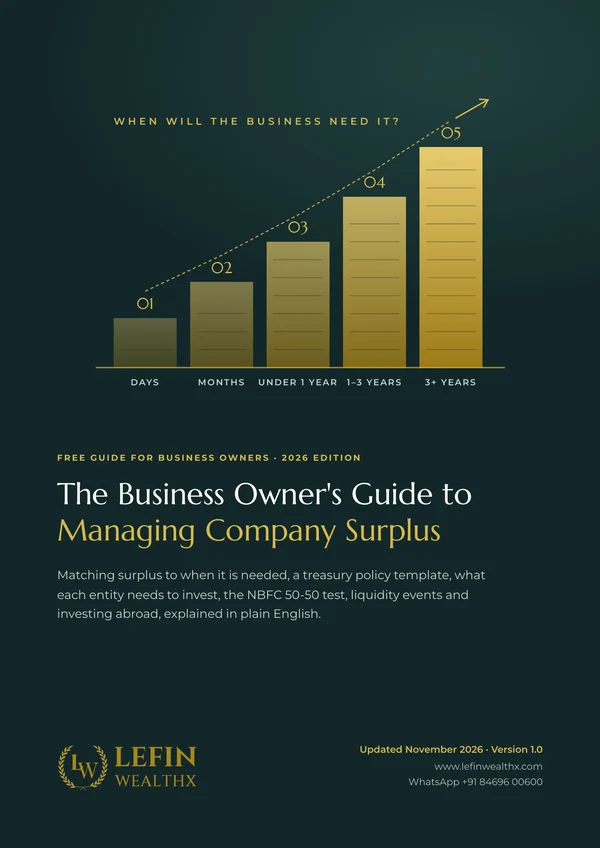
Where Should a Company Park Surplus Cash? A Practical Guide for Indian Businesses
How Indian companies, LLPs and firms can match surplus cash to when it will be needed: the five time buckets, overnight and liquid funds, Treasury Bills, arbitrage and debt funds, and the treasury policy that holds it together.
Read article →
Can a Private Limited Company Invest in Mutual Funds? Rules, Documents and Approvals
Yes, companies, LLPs, firms, HUFs and trusts can invest in mutual funds in their own names. What the board must approve, the documents needed, how section 186 and the NBFC test fit in, and practical tips.
Read article →
The NBFC 50-50 Test Explained for Holding Companies
When does a company that holds investments risk being treated as an NBFC? RBI's principal business test of 50% financial assets and 50% financial income, explained with an example, and what holding companies can do.
Read article →No articles on this topic for this audience yet.
Next step for Indian investors
Book a portfolio review with CA. Abhishek Mandhania: what you own, what it costs, and where the gaps are.
Global Funds
Holding part of your wealth outside one country


Global Funds for Resident Indians: LRS, TCS, Tax and Schedule FA, Step by Step
How a resident Indian can invest in an overseas fund under the Liberalised Remittance Scheme: the limit, the process, TCS, tax on gains and income, and annual reporting.
Read article →
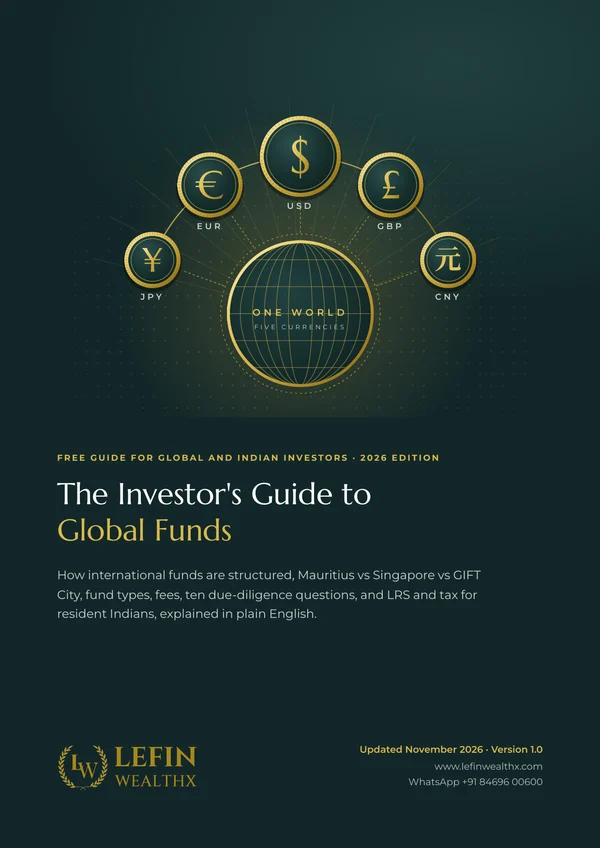
Mauritius, Singapore or GIFT City: How International Funds Are Structured
How international investment funds are set up in Mauritius, Singapore and GIFT City: the regulator, the fund vehicle, the administrator, auditor and bank, and what each means for investors.
Read article →
Ten Questions to Ask Before Investing in Any Offshore Fund
A due-diligence checklist for any international fund: regulator, administrator, bank, auditor, track record, strategy, fees, exit terms, tax and eligibility.
Read article →
Offshore Fund Fees Explained: Hurdle, Catch-Up and High-Water Mark
How management and performance fees work in international funds, what a hurdle, catch-up and high-water mark mean, and the questions to ask before you invest.
Read article →
What Is a Variable Capital Company (VCC)? A Plain-English Guide for Investors
A variable capital company is a fund vehicle that lets one company run several sub-funds with separate assets. How VCCs work in Mauritius and Singapore, and what they mean for your investment.
Read article →
Systematic (Quant) Investing Explained: How It Works and Its Risks
What systematic or quant investing is, how rule-based strategies such as momentum and mean reversion work, why short holding periods matter, and the risks every investor should understand.
Read article →No articles on this topic for this audience yet.
Next step for global investing
See which global fund fits you in 60 seconds, or read our free guide to Global Funds.
Free guides (PDF)
Choose your free guide
Plain-English guides by CA. Abhishek Mandhania. Pick a topic, then download it with a short form.